
How to get a job in Ireland from India 2025: 6 easy steps
This article covers:
- Key takeaways
- Key highlights
- Do you know?
- How to get a job in Ireland from India – 6 easy steps
- Job search timeline: How long does it take to get a job in Ireland?
- Best job opportunities in Ireland for Indian candidates
- Best cities in Ireland for Indian job seekers
- Eligibility for jobs in Ireland from India
- Work permits and immigration processes
- Ireland’s workplace culture
- Do’s and don’ts when applying for jobs in Ireland
- Quick checklist before applying for jobs in Ireland
- Before you go…
- FAQs on how to get a job in Ireland from India
Key takeaways
- Getting a job in Ireland from India in 2025 is possible with the right skills, planning and persistence.
- Ireland actively hires international talent, especially in IT, healthcare, engineering, finance, and management roles.
- An Irish-style CV, tailored applications, and use of trusted job portals significantly improve success rates.
- Securing a valid employment permit is mandatory before applying for an Irish work visa.
- Most Irish employers conduct remote interviews, making it feasible to apply directly from India.
- Understanding Ireland’s workplace culture and immigration process helps candidates integrate faster and avoid common mistakes.
As per a recent study, Ireland is listed among the top countries to work and generate wealth. Higher average salaries, relatively low tax burden, and excellent employee benefits are some of the major reasons why it is a highly sought-after destination among foreign job seekers.
The answer is yes—with the right strategy, preparation and understanding of Ireland’s job market and immigration system.
This updated guide explains how to get a job in Ireland from India in 2025, step by step, while covering job opportunities, eligibility, work permits, workplace culture and FAQs—all in one place.
Key highlights
- Top Job Sectors for Indians in Ireland: Healthcare, Engineering, IT, Management and Business.
- Average Hourly Wage for Part-Time Jobs: Around INR 1.2k (EUR 13)
- Annual Salary Range for Indian Freshers: INR 32.6L to INR 46.1L (EUR 35k to EUR 49.5k)
- Common Work Visas in Ireland:
- Critical Skills Employment Permit
- General Employment Permit
- Internship Employment Permit
Do you know?
- At 74.2%, the employment rate is at an all-time high since the survey began 25 years ago. A further increase of approximately 1.54% is expected by the end of 2024.[1]
- Effective from January 1, 2024, the National Minimum Wage rate in the country is increased from €11.30 to €12.70 per hour.[2]
- Ireland hosts the European headquarters of 9 out of the top 10 US tech giants.
- All of the world’s top 10 pharmaceutical companies have a presence in Ireland.
- 14 of the 15 leading global MedTech companies operate in Ireland.
How to get a job in Ireland from India – 6 easy steps
Step 1: Thoroughly research the Irish job market
Every country has a different job market and employment landscape, which significantly affects your job-hunting efforts. So, before you start applying for the desired job vacancies in Ireland from India, take enough time to learn about the Irish job market.
Focus on:
- Occupations listed under the Critical Skills Occupations List
- Industry growth areas such as IT, MedTech, Pharma and Financial Services
- Salary benchmarks and cost of living in cities like Dublin, Cork and Galway
Use official Irish government portals, industry reports and professional networks to validate opportunities.
Step 2: Prepare an Irish-style resume and cover letter
Your cover letter and curriculum vitae (CV) are the most important tools for displaying your qualifications, skills, and experience to prospective employers. That is why it becomes very crucial to design an ATS-friendly resume.
Here are some best practices to keep in mind:
- Limit CV length to 2–3 pages
- Highlight measurable achievements and technical skills
- Tailor your CV and cover letter for each job
- Include a short personal interests section (commonly preferred by Irish employers)
Avoid including unnecessary personal details such as marital status or passport numbers.
Step 3: Apply via trusted Irish job portals
Identifying the right job portals and Irish job websites is critical if you want to get a lucrative opportunity to work in Ireland from India.
Recommended job portals include:
You may also register with Ireland-based recruitment agencies that specialise in overseas hiring for skill-shortage roles.
Step 4: Prepare for remote interviews
Being shortlisted for an interview is great news, and you should not miss this opportunity. Most Irish employers conduct online interviews for international candidates.
Preparation tips:
- Research the company’s culture, products and values
- Practice competency-based and behavioural questions
- Be clear about visa sponsorship requirements
- Send a follow-up email after the interview
Strong communication skills and cultural awareness are highly valued.
Step 5: Secure an Irish work permit
To work legally in Ireland, Indian citizens must obtain an employment permit issued by the Department of Enterprise, Trade and Employment (DETE).
Depending on the role, the application may be submitted by:
- The Irish employer, or
- The candidate (or authorised agent)
Key details include job role, salary, employer registration and contract duration.
Step 6: Apply for an Ireland work visa
Once your work permit is approved, apply for the appropriate Ireland employment visa.
Here’s what the process will look like:
- Select the correct visa type.
- Complete the online application.
- Submit documents at the Irish Embassy or the Visa Application Centre.
- Pay the visa fee and wait for approval.
Make sure to submit complete and correct documents. In case your visa gets rejected for any reason, you will need to apply again after paying the visa fees again.
Job search timeline: How long does it take to get a job in Ireland?
If you’re an Indian professional planning to work in Ireland, it’s helpful to know that the process takes time. From sending out job applications to receiving your visa approval, the entire journey usually takes around 3 to 6 months.
Here’s what the process typically looks like:
Job search & applications (4–8 weeks)
This is the stage where you research roles, update your CV to match Irish hiring standards, and start applying. Some candidates hear back quickly, especially in high-demand sectors like IT or healthcare. Others may need a few weeks of consistent applications before landing interviews.
Interviews & job offer (2–6 weeks)
Employers in Ireland often conduct more than one interview, which may be spread out over several weeks. After interviews are completed, companies usually take additional time to review candidates, check references and prepare a formal offer letter.
Employment permit approval (4–8 weeks)
Once you accept a job offer, the next step is applying for an Irish employment permit. Processing times vary depending on the permit type and application volume, but this stage often requires patience, as approvals are handled by government authorities.
Visa processing (2–4 weeks)
After your employment permit is approved, you can apply for your visa. This involves submitting documents and waiting for a decision. If everything is in order, this step is usually completed within a few weeks.
Best job opportunities in Ireland for Indian candidates
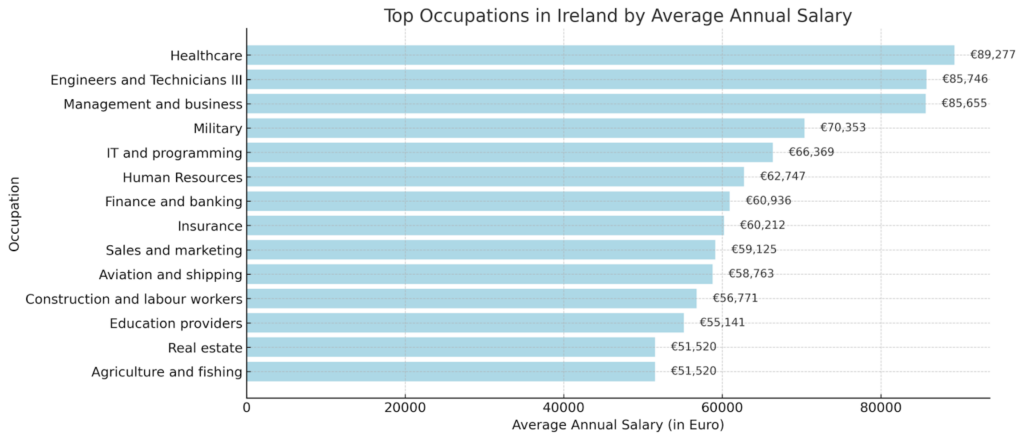
| Top occupations | Average annual salary (in Euro) |
| Healthcare | €89,277 |
| Engineers and Technicians III | €85,746 |
| Management and business | €85,655 |
| Military | €70,353 |
| IT and programming | €66,369 |
| Human Resources | €62,747 |
| Finance and banking | €60,936 |
| Insurance | €60,212 |
| Sales and marketing | €59,125 |
| Aviation and shipping | €58,763 |
| Construction and labour workers | €56,771 |
| Education providers | €55,141 |
| Agriculture and fishing | €51,520 |
| Real estate | €51,520 |
Source: Average Salary Survey
Also Read: Highest paying part-time jobs for students in Ireland
Best cities in Ireland for Indian job seekers
While jobs are available across Ireland, certain cities offer better opportunities, salaries and international exposure:
| City | Key industries & job opportunities |
| Dublin | Technology, finance, professional services |
| Cork | Pharmaceuticals, manufacturing, technology |
| Galway | MedTech, digital innovation, healthcare & varied services |
| Limerick | Engineering, professional & technical services, growing tech |
| Waterford | Manufacturing, services, growing tech & ICT |
Eligibility for jobs in Ireland from India
To work in Ireland, Indian applicants must meet the following requirements:
- Skills and qualifications: Every job vacancy in Ireland for Indian candidates requires a certain level of educational qualifications. In most cases, a bachelor’s or master’s degree is enough. Some jobs also require some additional skills and certifications.
- English proficiency: You must have a higher level of English language proficiency if you want to work and settle in Ireland. Some jobs even require IELTS as proof of your proficiency in the English language.
- Medical requirements: While employers do not have specific health requirements, you must submit a medical certificate at the time of applying for a visa.
- Clean criminal history: Similar to the above requirement, a Police Clearance Certificate (PCC) is required to obtain a work visa.
Work permits and immigration processes
Type of Irish work permits
- Critical Skills employment permit: This Irish work permit is granted to applicants who are hired under a ‘highly skilled occupation’. It requires a valid job contract for a minimum period of two years.
- General employment permit: As the name suggests, it is a general work permit that comes with the same validity as the duration of the job contract.
- Intra-company transfer employment permit: Granted to the applicants who are transferred to the Ireland branch of their existing organisation.
- Sports and cultural employment permit: It is issued to professionals who have qualifications in the field of sports.
- Dependent/spouse/partner employment permit: This work permit is designed for the partners/spouses/dependents of the Critical Skills Employment permit holders. It allows the permit holders to stay and work in Ireland.
Immigration process for Ireland
- Step 1: Get an Irish offer letter.
- Step 2: Obtain a work permit from the Department of Business, Enterprise and Innovation (DBEI).
- Step 3: Select a relevant visa.
- Step 4: Apply online via the Irish Naturalisation and Immigration Service (INIS).
- Step 5: Pay the visa application fees.
Also Read: 10 best countries to study abroad
Ireland’s workplace culture
Ireland has one of the most educated workforces in the world. It is a clear reflection of how people work here. Every Irish business or profession has a different workplace culture.
Below are some points that explain the common business etiquette in the country:
- Investing in your skills is the key to rising to the top.
- Most workplaces do not follow a strict hierarchical approach. It is common to see senior professionals socialising with junior colleagues.
- Informal but direct communication is encouraged most of the time.
- Punctuality is of primary importance.
- Business meetings are usually casual and often take place in social settings such as bars and restaurants.
- Maximum working hours are set at 48 hours per week, and each employee is entitled to a minimum of 20 paid leaves.
- To maintain a positive work-life balance, the Irish government has introduced the Right to Disconnect. It grants the right to switch off or disconnect from work outside the normal working hours.
Do’s and don’ts when applying for jobs in Ireland
Do’s
- Learn how to create an Irish-style resume and cover letter.
- Understand work visa requirements.
- Look for opportunities to upskill yourself.
- Apply to authentic Irish job websites.
- Build a strong professional network.
- Reach out to your friends/colleagues working in Ireland.
- Learn about Irish culture and way of living.
Don’ts
- Don’t settle for low-paying or seasonal jobs.
- Don’t apply for jobs that don’t align with your qualifications.
- Don’t lie in your resume.
- Don’t limit yourself to only one industry or job sector.
- Don’t fall for job-related scams.
- Don’t lose hope.
Quick checklist before applying for jobs in Ireland
Before you start submitting applications, make sure you have the following in place. Being prepared upfront can improve your chances of getting interviews and help avoid delays later in the process.
Updated Irish-style CV and cover letter
Your CV should follow Irish standards: clear layout, concise bullet points and a strong focus on skills and achievements. Tailor your cover letter for each role.
Skills aligned with Ireland’s shortage occupations
Check whether your role appears on Ireland’s Critical Skills or General Employment Permit occupation lists. Employers are more likely to sponsor candidates whose skills are in demand.
Understanding of the correct employment permit type
Know which employment permit you are eligible for before applying. Some roles qualify for a Critical Skills Employment Permit, while others fall under the General Employment Permit.
Prepared supporting documents
Keep essential documents ready, including your degree certificates, employment or experience letters, passport and Police Clearance Certificate (PCC).
Active LinkedIn profile and professional references
Ensure your LinkedIn profile is updated, keyword-optimised and consistent with your CV. Be ready with at least two professional references who can verify your work experience if requested by employers.
Before you go…
With a lower unemployment rate and a growing economy, it is safe to say that Ireland is a land of opportunities for Indian job seekers. So, without having any second thoughts, follow the process mentioned in the blog and take your first step towards turning your dream of working in Ireland into reality.
We understand that moving to a new country can be very challenging, especially in terms of managing finances. During this transition, you might need to transfer funds from India to Ireland and vice versa.
Always opt for a trusted money transfer service like Instarem. Apart from offering secure fund transfers to 60+ nations across the globe, Instarem also offers affordable# exchange rates and fast** and simple transaction processing.
FAQs on how to get a job in Ireland from India
How to find jobs in Ireland from India?
There are various platforms where you can find jobs in Ireland from India. These include Irish job portals for Indians, government-owned job banks, and platforms such as LinkedIn.
Is it possible to get a job in Ireland from India?
Yes. It is possible to get a job in Ireland from India. However, it is not as simple as getting a job in the home country. It requires a lot of research, dedication, and a well-planned approach.
Which job is best for an Indian in Ireland?
The best job for Indian candidates in Ireland depends on their specific skills, qualifications, career objectives, and personal interests. Nevertheless, sectors like IT, healthcare, sales & marketing, and finance attract huge numbers of Indian job seekers.
Does Ireland need IELTS for a job?
Yes, most Irish work permits require an IELTS band score of at least 6.0 in all four sections: Listening, Reading, Writing, and Speaking. Besides, a higher band score may be required for jobs that require direct communication with customers, such as sales, educational services, hospitality services, and so on.
Can I directly apply for a job in Ireland?
If you want to get assistance from Irish recruitment agencies, then you can apply directly for jobs on Irish job websites like GrabJobs, Indeed, Monster, etc. You can also apply on the official websites of your target Irish companies.
How to get a job offer in Ireland from India without PR?
If you don’t have a PR, then you will need to obtain a work permit for Ireland. There are many Irish job websites where you can find and apply for suitable jobs and get a job offer from an Irish employer. Once you have a valid job offer, there will be no problem getting an Irish work permit.
How much can an international student earn in Ireland?
From January 1, 2024, the national minimum wage in Ireland is €12.70 per hour. However, not everyone is entitled to it. In large cities like Cork and Dublin, most students get hourly rates ranging from €10 to €12 per hour.
In other cities, the minimum wage for part-time workers is around €8 to €9 per hour. However, there are several high-paying part-time jobs for students in Ireland. Moreover, students are not allowed to work for more than 20 hours per week during their course and 40 hours per week during their breaks.
What is the age limit for working in Ireland?
The minimum age limit for working in Ireland is 14 years. Further, there are certain restrictions and rules for minor workers. Once you are 18, you can work as a regular employee.
Can I get work-from-home jobs in Ireland from India?
The chances of working remotely in Ireland are very low. Irish companies rarely have a provision for work from home in Ireland from India. Hence, it is advisable to obtain a work permit and join a company as a full-time on-site employee.
Disclaimer:
- This article is intended for informational purposes only. All details are accurate at the time of publishing. Instarem has no affiliation or relationship with products or vendors mentioned.
- ** Fast meaning 75% of our transactions are completed in 15 minutes. Depending on the funding method.
- # When it comes to affordable exchange rates and fees, it’s worth noting that the cost will vary depending on how you choose to fund your transactions. Credit card funding and bank transfer fees can differ significantly.
References: