



What is the best time to transfer SGD to MYR?: A guide for expats

This article covers:
- Key takeaways
- How the SGD ↔ MYR exchange rate works & what drives fluctuations
- Why does the ‘best rate’ matter?
- Monetary policy
- Supply and demand for MYR
- Recent trends: What SGD → MYR rates looked like (Past 6–12 months)
- When to change SGD to MYR: Key considerations for expats
- Limitations & what you can’t predict
- Currency conversion tips for expats
- Who should use this guide — Common scenarios for expats & travellers
- Why use Instarem for SGD to MYR transfers
- SGD to MYR transfers: Frequently asked questions
The best time to transfer SGD to MYR is when:
- SGD is near the upper end of its recent 3–6 month range
- Market volatility is low
- Your provider offers a tight exchange spread
- You don’t risk missing payment deadlines
Quick Checklist: Is It a Good Time to Transfer?
- Is SGD above its 30-day average?
- Are MAS or BNM announcements due this week?
- Is it a weekday during market hours?
- Have you compared at least two providers?
- Is your payment deadline within 3 days?
Key takeaways
- There’s no single ‘perfect’ time. Context matters. The best time to transfer SGD to MYR depends on the exchange rate, fees, market conditions and your personal cash-flow needs, not just chasing the highest number.
- Small rate changes add up over time. Even a 1–2% difference in the SGD → MYR rate can translate into meaningful gains or losses, especially for regular or large transfers.
- Always look beyond the headline rate. Banks and providers may hide costs in wider spreads, so focus on how much MYR you actually receive after fees, not just ‘zero-fee’ claims.
- Timing tools reduce stress and guesswork. Watching historical trends, setting rate alerts and avoiding weekends or holidays can help you act when rates are relatively favourable.
- Consistency beats perfection for most expats. If you have fixed obligations, reliability and timely transfers matter more than waiting endlessly for the absolute best rate.
When you earn in Singapore dollars but still manage expenses in Malaysia, currency exchange becomes a constant presence in your financial life.
For expats, transferring money across borders is a necessity. You pay for family expenses, maintain property, and support long-term plans back home. It becomes a recurring decision that subtly shapes how far your income can actually go.
Most people prioritise speed and convenience. Transfers are made when they’re needed, with little attention paid to the rate. But as months turn into years, differences begin to stand out. The same transfer amount can result in noticeably different MYR values, even when nothing else about your spending or income has changed.
This is why knowing when to transfer money can therefore become part of a more thoughtful financial approach. With a clearer understanding of how the SGD–MYR rate behaves and what typically influences its movements, expats can make more informed timing decisions rather than relying on guesswork or habit.
In this guide, we will discuss when the best time is to exchange SGD for MYR as an expat and the practical strategies you can use to ensure that when you hit ‘send,’ you’re getting the most out of every hard-earned dollar.
How the SGD ↔ MYR exchange rate works & what drives fluctuations
If you’ve ever exchanged Singapore dollars (SGD) for Malaysian ringgit (MYR), you may have noticed that the rate isn’t always the same. One day you might get 3.25 MYR for 1 SGD, and the next, it could drop to 3.10.
Understanding how the SGD ↔ MYR exchange rate works, and why it fluctuates, can help you time your transfers better and get the most value for your money.
Understanding the ‘mid-market’ or interbank rate
At the heart of every currency exchange is the mid-market rate, sometimes called the interbank rate. This is the rate at which major banks and financial institutions trade currencies among themselves.
It’s essentially the ‘true’ rate of the currency at that moment, determined by supply and demand in the global foreign exchange (forex) market.
However, when you exchange money at a bank or money changer, you rarely get this exact rate. Instead, you see a Spread.
This is the difference between the mid-market rate and the rate offered to you. It covers the provider’s overheads (rent, staff, security) and their profit margin.
Why does the ‘best rate’ matter?
A difference of just 1% might seem small, but if you are changing SG$2,000, a ‘bad’ rate could cost you an extra 60 to 80 MYR. In a competitive market, finding a provider that offers a rate closest to the mid-market rate is the goal.
Why currency rates fluctuate
The SGD ↔ MYR rate is rarely static. Several key factors drive these fluctuations, including:
Monetary policy
This is the most technical but important factor.
- Singapore (MAS):
- Singapore’s central bank, the Monetary Authority of Singapore (MAS), manages inflation primarily through the exchange rate rather than conventional interest rate targeting, according to MAS’s official policy framework.
- Malaysia (BNM): Bank Negara Malaysia (BNM) manages monetary policy primarily through its Overnight Policy Rate, as outlined in its monetary policy statements.
<h4> Political & market sentiment </h4>
Currencies do best when things are stable. When politics are predictable, or the government rolls out growth-friendly policies (like the recent focus on the Johor-Singapore Special Economic Zone), investors feel confident. That confidence often leads big players to buy Ringgit assets, which pushes its value up.
On the other hand, during global uncertainties, such as geopolitical tensions, investors tend to retreat to safer options like the Singapore Dollar, causing the Ringgit to drop.
Supply and demand for MYR
The basic principle of supply and demand plays a big role in determining the SGD ↔ MYR rate.
- Trade flows: Malaysia exports and imports goods and services. When foreign businesses or tourists need MYR to pay for goods, demand rises, pushing up its value.
- Remittances & investments: Large inflows of foreign investment into Malaysia increase demand for MYR. Conversely, when capital leaves the country, the currency may weaken.
- Tourism: Seasonal tourism spikes can increase demand for MYR temporarily.
Recent trends: What SGD → MYR rates looked like (Past 6–12 months)
To understand where the market might go next, we first have to look at where we’ve been.
Overview of recent movement
Earlier in 2025, the exchange rate was a dream for anyone sending money from Singapore to Malaysia.
However, as we move through late 2025, the narrative has shifted. The Ringgit has staged a powerful comeback. As of today, the rate is hovering around 1 SGD ≈ MYR 3.18. While this might feel like a ‘loss’ for those used to the 3.30+ days, it reflects a much more stable and strengthening Malaysian economy.
SGD MYR exchange rate history in 2025
To make the changes easier to digest, here’s a snapshot of key points through the year (Historical SGD → MYR exchange rate data referenced here is based on publicly available charts from ValutaFX):
| Period / Date Range | Approx. SGD → MYR Rate | Trend Summary |
| December 2025 (~Mid–Late) | ~3.15–3.18 MYR | Lower end of 2025 range; stronger MYR relative to SGD. |
| Late November 2025 | ~3.17–3.19 MYR | Slight pullback from mid-year highs. |
| October 2025 | ~3.23–3.25 MYR | Gradual weakening of SGD/MYR after mid-year peaks. |
| September 2025 peak period | ~3.27–3.28 MYR | Mid-range level before year-end softening. |
| June 2025 | ~3.30–3.31 MYR | Solid strength for SGD, building toward peak. |
| April 2025 (Highest point) | 3.3658 MYR | Highest SGD value in 2025 — excellent for SGD holders. |
| Early 2025 / Jan–Feb 2025 | ~3.24–3.30 MYR | Early-year range before peak rally. |
The SGD → MYR rate was strongest around mid-April 2025, giving Singapore dollar holders more ringgit for each dollar. After that peak, the rate gradually moderated, trending lower through the latter half of the year into December 2025, where it hovered near the lower end of the year’s range.
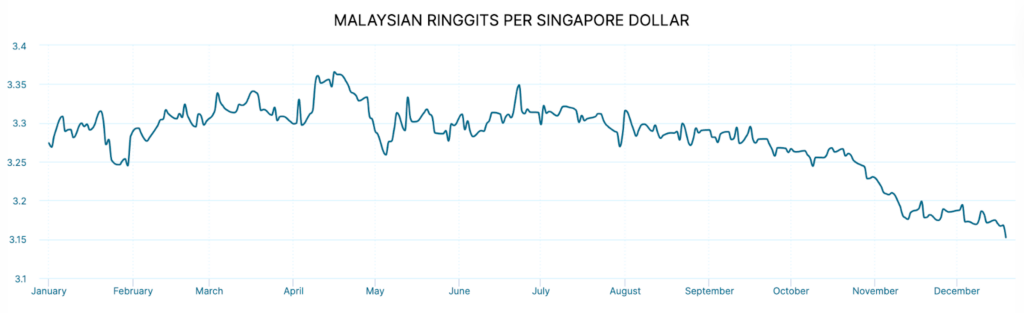
Image source: SGD to MYR 2025 Historical Chart by Valuta FX
When to change SGD to MYR: Key considerations for expats
When people talk about the ‘best time’ to transfer money from Singapore dollars (SGD) to Malaysian ringgit (MYR), it’s easy to assume there’s a single perfect moment you’re supposed to wait for.
In reality, the best time depends on a combination of exchange rates, market conditions, fees and your personal needs. For expats, understanding these factors can help you make smarter, less stressful transfer decisions.
Rate level and currency strength
The goal is simple: You want to exchange your SGD when it has the highest possible ‘purchasing power’ against the MYR. In forex terms, this means waiting for a spike.
For example, when the exchange rate rises from 3.18 to 3.34 MYR per SGD, the same amount of SGD will give you noticeably more ringgit. On larger transfers, this difference can translate into meaningful savings or extra funds for daily expenses, rent or family support.
While it’s impossible to predict exact peaks, keeping an eye on recent trends can help you recognise when the rate is relatively favourable compared to its usual range.
Market volatility and news events
Always keep in mind that exchange rates don’t move randomly. They respond to economic data, policy decisions and political developments in both Singapore and Malaysia.
Some common triggers include:
- Singapore factors: Watch for announcements from the Monetary Authority of Singapore (MAS). Since Singapore uses the exchange rate as its main tool for inflation, an MAS policy change can instantly make the SGD stronger.
- Malaysia factors: Pay attention to Bank Negara Malaysia (BNM) interest rate decisions and national budget announcements.
- Political events or policy announcements, including elections, budget updates or regulatory changes.
- Global market events that affect regional currencies.
During periods of volatility, rates can move quickly, sometimes within hours or days. Being aware of major news events can help you decide whether to act promptly during a favourable move or wait if uncertainty is high.
Exchange method and fees
You could find the perfect market spike, but if you use the wrong transfer method, your gains will be swallowed by fees. The ‘best time’ can be futile if you aren’t using the best channel.
- The hidden cost of banks: Traditional banks often promote zero-fee transfers, but their profit is built into a wider exchange rate spread. In practice, this means you receive a rate that’s noticeably worse than the mid-market rate you see on Google.
- Fintechs: Services like Instarem typically offer the mid-market rate (the real one) and charge a transparent, upfront fee.
- Money changers: While physical money changers can be competitive for cash, they rarely beat the convenience and rates of specialised digital remittance platforms for large electronic transfers.
Choose the right channel. A slightly weaker exchange rate with low fees can sometimes result in more MYR received than a stronger rate paired with high fees.
For expats making regular transfers, comparing providers can lead to consistent savings over time.
Urgency vs. waiting for the ‘perfect’ rate
This is the most important human factor. It is easy to get caught up in ‘analysis paralysis,’ waiting for the rate to hit 3.25 when it’s currently 3.20.
But remember the golden rule: Never let the pursuit of a perfect rate jeopardise your financial obligations.
- Fixed obligations: If you have a mortgage payment, credit card bill or school fees due in Malaysia on the 30th, the best time is at least 3 business days before the deadline. The RM 50 you might save by waiting for a better rate is not worth the RM 100 late fee or the stress of a missed payment.
- Discretionary Savings: If you are just moving extra cash to a Malaysian high-yield savings account, you have the luxury of time. In this case, set a Rate Alert and wait for the market to come to you.
Consistency and reliability matter just as much as squeezing out every last cent.
Limitations & what you can’t predict
While understanding exchange rates and monitoring trends can help you make better decisions, it’s just as important to recognise the limitations of timing the currency market.
No guide, chart or tool can remove uncertainty entirely. Knowing what you can’t predict helps you manage expectations and avoid costly assumptions.
Currency markets are inherently unpredictable
Foreign exchange markets are influenced by countless factors—many of which change rapidly or emerge without warning. Even if the SGD → MYR rate has reached strong levels in the past, there is no guarantee it will return to those exact highs.
Historical peaks are useful for context, but they are not promises. A rate that looked ‘high’ last year may never reappear, or it may take much longer than expected. Waiting too long in hopes of repeating a previous peak can sometimes result in missed opportunities or weaker rates.
External events can cause sudden and abrupt shifts
Even during periods that appear historically favourable, unexpected events can disrupt the market quickly. This is often called a black swan event.
Examples include:
- Economic slowdowns or recessions
- Sudden interest rate or monetary policy changes
- Political developments, elections or policy announcements
- Global shocks such as financial crises or geopolitical tensions
These events can cause exchange rates to move sharply within hours or days, sometimes in ways that contradict historical trends. This is why even well-timed transfers can be affected by sudden volatility.
Fees and conversion costs can offset a good rate
A favourable exchange rate alone doesn’t guarantee better value. Fees and hidden markups can quietly reduce how much MYR you actually receive.
Common costs to watch for include:
- Built-in exchange rate markups
- Transfer or processing fees
- Receiving bank charges on the MYR side
In some cases, a provider advertising a strong rate may still deliver less value once all fees are applied. This means that even if you transfer at a good time, poor pricing transparency can cancel out the benefits.
Always focus on the total cost and final amount received, not just the headline exchange rate.
Currency conversion tips for expats
Knowing how the market works is only half the battle; knowing how to act on that information is where you actually save money.
Here are expat-friendly tips you can apply to get the best SGD to MYR rate for travelling or transfer.
Watch exchange-rate charts & historical trends
One of the easiest ways to improve your timing is to get familiar with how the SGD/MYR rate usually moves.
Most currency platforms show daily, monthly and yearly charts. By looking at historical trends, you can:
- See the normal range the rate tends to move within.
- Identify periodic spikes when SGD temporarily strengthens.
- Avoid transferring during unusually weak periods unless necessary.
You don’t need to analyse every fluctuation. Simply checking charts once or twice a week can help you recognise when the rate is relatively strong compared to recent months.
Use real-time currency converters and rate alerts
Most modern fintech apps like Instarem allow you to set Rate Alerts.
Instead of waiting for a good rate, decide on a target rate. For example, if the current rate is 3.18, set an alert for 3.21.
Your phone will ping the moment the market hits your target. This allows you to strike while the iron is hot without having to monitor the markets 24/7.
Avoid weekends and public holidays
Foreign exchange markets are most active during weekday business hours. On weekends and public holidays:
- Trading volume is lower.
- Rates may include wider margins.
- Providers often build in extra buffers to protect against volatility.
As a result, you may get a slightly worse rate or face limited options. When possible, plan your transfers during regular market hours on weekdays, especially if timing and value matter.
Compare multiple providers, not just the headline rate
Exchange rate providers often present their pricing in ways that make transfers appear more affordable than they truly are.
- The ‘zero fee’ misconception
When a bank or provider advertises ‘zero commission,’ the cost is usually built into a less favourable exchange rate. In other words, the rate you receive is typically lower than the mid-market rate.
- Focus on the final amount
Rather than comparing fees or headline rates in isolation, evaluate how much MYR you actually receive for every SGD 1,000 sent.
- Provider A: Offers a stronger exchange rate but charges a SGD 15 fee.
- Provider B: Charges no visible fee but applies a weaker exchange rate.
In most cases, the better choice is the provider with the tightest spread. That is, the exchange rate closest to the mid-market rate.
Lock in rates when they’re favourable
Currency markets are notoriously unpredictable. If you see a rate that is significantly higher than the last two weeks’ average, and you have the funds available, lock it in.
Some services allow you to:
- Convert funds at the current rate and hold them
- Schedule transfers in advance
- Complete the transfer instantly to avoid sudden reversals
Markets can turn quickly. A good rate today doesn’t guarantee a better one tomorrow. Acting when conditions are favourable can remove guesswork and reduce stress.
Who should use this guide — Common scenarios for expats & travellers
This is for anyone who regularly deals with the SGD ↔ MYR exchange rate and wants to make more informed decisions when converting or transferring money.
If your income, savings or expenses span both Singapore and Malaysia, understanding how and when to exchange currencies can make a real difference. Below are some common scenarios where this guide is especially useful.
Expats earning or saving in SGD but spending in MYR
Many expats work or hold savings in Singapore dollars while covering daily expenses in Malaysia, such as housing, food, education or healthcare. In this situation, exchange rates directly affect your cost of living.
A small shift in the SGD → MYR rate can mean:
- Higher or lower monthly expenses
- Changes in how far your salary or savings stretch
- The need to plan transfers around rent, school fees or other fixed costs
This guide helps you understand when the SGD is relatively strong, so you can time transfers more effectively and avoid converting money during unfavourable periods.
People sending money to family or friends in Malaysia
For many, sending money home is a non-negotiable monthly task. You might be supporting elderly parents in KL, paying for a sibling’s university tuition or contributing to a family fund.
Over time, small differences in rates can add up.
This guide is helpful if you:
- Send money monthly or quarterly
- Want to maximise how much MYR your recipient receives
- Are choosing between banks, money changers or online remittance services
Travellers or frequent visitors to Malaysia
If you’re travelling for leisure, business or frequent short trips, currency exchange plays a role in your overall travel budget.
For travellers, this guide is useful to:
- Decide when to exchange SGD for MYR before your trip
- Understand whether it’s better to convert cash in Singapore or Malaysia
- Avoid poor exchange rates at airports or during weekends and holidays
Even for short trips, exchanging at a better rate can mean more spending power for accommodation, food, shopping and experiences.
Freelancers or businesses managing cross-border payments (SG ↔ MY)
With the rise of the Johor-Singapore Special Economic Zone, more freelancers and small businesses are working across the border. You might be a Singaporean designer hiring a Malaysian developer, or a JB-based consultant billing a Singaporean client.
In this scenario, you deal with invoices, salaries or vendor payments in different currencies. Business transfers involve higher stakes, including tax considerations and the need for clear transaction records.
This is why opening a multi-currency business account is important. They allow you to hold MYR when the rate is favourable and pay suppliers instantly without losing a chunk to Interbank fees.
Why use Instarem for SGD to MYR transfers
When it comes to moving money across borders, especially between Singapore (SGD) and Malaysia (MYR), Instarem has become a popular choice for many expats. Its platform is built to make transfers faster, cheaper and more transparent compared with traditional banks. Below are the key reasons why Instarem stands out:
Transparent, low-cost transfers
One of Instarem’s main selling points is that it offers competitive exchange rates with low, upfront fees. Unlike many banks or exchangers that add hidden mark-ups to the currency rate or sneak in extra charges, Instarem shows you the total cost before you confirm your transfer.
No surprises at the end. This means you know exactly how much MYR your recipient will receive when sending SGD.
This transparency helps you compare real costs easily and avoid the common trap of choosing a ‘good rate’ that turns out to be offset by high fees.
Fast and convenient transfers
Using traditional banks for international transfers often means dealing with long processing times, paperwork and limited visibility. Bank transfers can take two to four business days, sometimes longer if intermediary banks are involved or if the transfer falls near a weekend or public holiday.
Instarem removes these pain points.
For popular corridors like SGD → MYR, transfers are often completed on the same day or even instantly, depending on the transfer method and timing. This speed makes a real difference when you’re sending money for urgent needs such as family support, rent, bills or last-minute expenses.
The process is also far more convenient. Instead of visiting a bank branch or filling out lengthy forms, you can:
- Initiate transfers online or via the mobile app
- See the exchange rate and fees upfront
- Track your transfer status in real time
Easy to use with rewards
Instarem is built for users who want simplicity and added perks.
- You can manage transfers directly through the app or online dashboard.
- The interface shows live rates, estimated transfer times and status tracking at every step.
- Users also earn InstaPoints on each transfer and for referrals, which can be redeemed for fee discounts on future transfers.
Wide global reach
While your focus might be SGD ↔ MYR transfers, Instarem supports sending money to over 60+ countries, making it a one-stop solution if you also remit to other destinations.
This means you don’t need separate services for different corridors. You can manage all your international transfers under one account.
Ready to make your first SGD → MYR transfer? Sign up with Instarem today and experience faster, cheaper and more transparent international transfers. Start sending money with confidence and get more MYR for every SGD you transfer.
SGD to MYR transfers: Frequently asked questions
How often should I check exchange rates before making a transfer?
For expats sending money regularly, checking rates once or twice a week is usually sufficient. If you have flexibility and are waiting for a favourable rate, you can also set rate alerts via apps like Instarem to notify you automatically.
Are there any tax implications for sending large sums from Singapore to Malaysia?
For most expats, sending money for personal use, family support or mortgage payments is not taxed as income in Malaysia. However, if you are transferring very large amounts (e.g., for property purchases or business investments), the Central Bank of Malaysia (Bank Negara) may require documentation to prove the source of funds to comply with Anti-Money Laundering (AML) regulations.
Pro Tip: Always keep your transfer receipts and bank statements from Singapore just in case you are asked for verification by your Malaysian bank.
Is there a specific day of the week that is best for transferring money?
While the forex market is unpredictable, historical trends often show that Tuesdays and Wednesdays are generally more stable. By mid-week, the market has ‘digested’ the weekend news and Monday’s opening volatility.
Avoid Fridays if you can. If the transfer doesn’t clear before the weekend, your money might be stuck in ‘limbo’ while the market potentially shifts against you by Monday morning.
Can I transfer MYR back to SGD using the same strategies?
Yes. The same principles—monitoring rates, checking fees and using reliable providers—apply in both directions. Be aware that market conditions may differ, so rates favourable for SGD → MYR may not mirror MYR → SGD.